
 繁體中文
繁體中文  简体中文
简体中文  English
 The Seven-Level Qualification System established by the International Association for Professional Certification (IAPC) is one of the Association’s most distinctive professional certification frameworks. Unlike conventional certification systems that grant graduates only a single fixed title upon course completion, IAPC places greater emphasis on the continuous professional development, years of service, practical experience, professional contributions, and accumulated capabilities of individuals after completing their training.
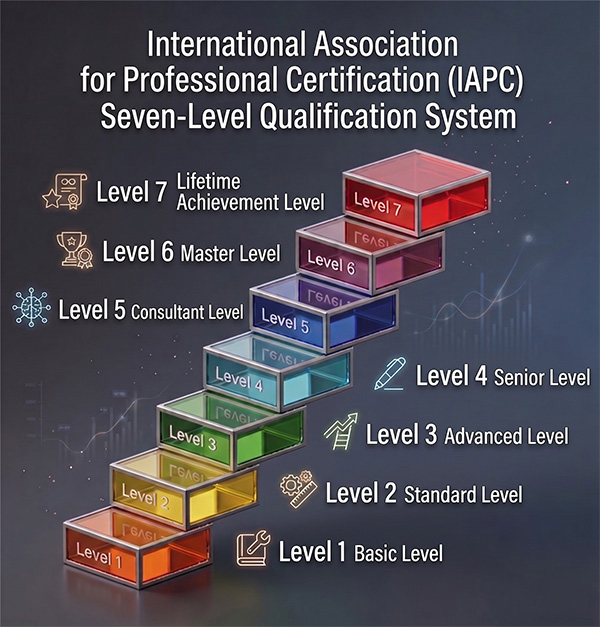
In many professional fields, a beginner who has just completed training and a senior professional who has worked in the field for many years, served numerous clients, trained students, developed techniques, or contributed to the industry may share the same professional title. However, there may be significant differences in their depth of experience, professional judgement, quality of service, and professional value.
The IAPC Seven-Level Qualification System was designed to clearly recognise these differences and provide a more complete and structured way to represent each professional’s level of competence, development journey, practical experience, and contribution.
2. Core Principles of the Seven-Level Qualification System
IAPC believes that professional qualifications should extend beyond the single criterion of whether a person has completed a course. They should also reflect the individual’s level of learning, practical experience, service capability, teaching ability, research achievements, industry contributions, and professional influence within the relevant field.
The Seven-Level Qualification System is therefore more than a certificate grading system. It is a professional development pathway that supports individuals as they progress from foundational learning to the accumulation of competence and experience, advanced technical development, expanded professional services, consultancy, mastery, and lifetime achievement.
Through this system, students, clients, partner organisations, and the general public can more clearly understand a professional’s current level of competence and professional positioning. Professionals can also present their qualifications and development achievements with greater credibility and distinction.
3. Seven-Level Qualification Framework
Level 1 Basic Level
The Basic Level indicates that the applicant possesses the fundamental knowledge, introductory skills, and basic capabilities required in the relevant professional field. This level is suitable for students or practitioners who have completed foundational training, are developing their professional abilities, and are preparing to enter the practical application stage.
The purpose of the Basic Level is to confirm that the applicant has acquired the essential concepts, operating principles, and learning foundations of the profession, providing a starting point for further professional development.
Eligibility Requirement:
The applicant possesses the basic capabilities required in the relevant profession.
Level 2 Standard Level The applicant possesses the basic capabilities required in the relevant profession.
The Standard Level indicates that the applicant possesses a comprehensive range of capabilities required in the relevant profession and can understand and apply its core knowledge, essential techniques, and service procedures. This level represents an important transition from the learning stage to formal professional application.
Holders of the Standard Level qualification are generally capable of performing relevant professional work in a comprehensive manner and are prepared to accumulate further practical experience and develop advanced capabilities.
Eligibility Requirement:
The applicant comprehensively possesses the capabilities required in the relevant profession.
Level 3 Advanced Level The applicant comprehensively possesses the capabilities required in the relevant profession.
The Advanced Level indicates that, in addition to possessing the capabilities required in the relevant profession, the applicant has broader related knowledge, skills, and practical understanding. This level is suitable for individuals who have accumulated experience in the field and can demonstrate deeper professional judgement and application capabilities.
Applicants may demonstrate through practical experience, research achievements, professional contributions, or continuing education that they have progressed beyond the basic and standard stages into a more mature stage of professional development.
Eligibility Requirements — applicants must meet at least one of the following:
Level 4 Senior Level - Possess broader related knowledge and skills in addition to the capabilities required in the relevant profession.
- Hold a Level 2 Standard Level qualification and have at least one year of relevant practical experience.
- Have conducted in-depth research or made a significant contribution to a related field.
The Senior Level indicates that the applicant has developed mature professional capabilities and practical experience and can demonstrate consistent service competence, technical maturity, or recognised achievements in the relevant field. This level is suitable for individuals who have maintained continued involvement in the profession and have developed their own professional style and depth of service.
The Senior Level considers not only years of experience but also the applicant’s ability to transform that experience into consistent professional performance and identifiable achievements in practice, teaching, research, creative work, or professional service.
Eligibility Requirements — applicants must meet at least one of the following:
Level 5 Consultant Level - Hold a Level 3 Advanced Level qualification and have at least one year of relevant practical experience.
- Possess broader related knowledge and skills.
- Have conducted in-depth research or made a significant contribution to a related field.
- Have produced verifiable achievements or contributions in the relevant field.
Progression within the Level: This level is further divided into five grades. An applicant may apply for advancement by one grade each year in accordance with the applicable requirements.
The Consultant Level indicates that the applicant possesses advanced professional judgement, analytical integration, and advisory capabilities and can provide individuals, groups, organisations, or course providers with in-depth professional advice and service planning. This level is suitable for individuals with extensive practical experience who are capable of consultation, teaching, coaching, planning, or professional guidance.
The value of the Consultant Level lies in the applicant’s ability to go beyond performing established techniques. The applicant can assess different needs, design appropriate solutions, analyse problems, and provide systematic professional support, demonstrating a higher level of professional maturity.
Eligibility Requirements — applicants must meet at least one of the following:
Level 6 Master Level - Hold a Level 4 Senior Level qualification and have at least five years of relevant practical experience.
- Possess broader related knowledge and skills.
- Have conducted in-depth research or made a significant contribution to a related field.
- Have produced verifiable achievements or contributions in the relevant field.
Progression within the Level: This level is further divided into five grades. An applicant may apply for advancement by one grade each year in accordance with the applicable requirements.
The Master Level indicates that the applicant has acquired extensive experience, mature expertise, and recognised achievements in the relevant professional field. The applicant may also possess the ability to train professionals, establish systems, develop methodologies, or contribute to the advancement of the industry. This level is suitable for individuals who have devoted many years to their profession and established a high degree of professional influence.
The Master Level represents more than years of experience. It emphasises the applicant’s professional depth, transfer of knowledge and skills, teaching capability, system development, and contribution to the field. For many professionals, this level represents significant recognition of their long-term development and accumulated achievements.
Eligibility Requirements — applicants must meet at least one of the following:
Level 7 Lifetime Achievement Level - Hold a Level 5 Consultant Level qualification and have at least five years of relevant practical experience.
- Possess broader related knowledge and skills.
- Have conducted in-depth research or made a significant contribution to a related field.
- Have produced verifiable achievements or contributions in the relevant field.
Progression within the Level: This level is further divided into five grades. An applicant may apply for advancement by one grade each year in accordance with the applicable requirements.
The Lifetime Achievement Level is the highest level within the IAPC Seven-Level Qualification System. It recognises individuals who have demonstrated long-term dedication, substantial achievements, and significant contributions to a specific profession, industry, education, culture, society, or the development of professional talent.
This level recognises more than individual competence. It also considers long-term contributions, professional commitment, the value of knowledge transfer, and sustained influence. The Lifetime Achievement Level honours individuals who have devoted many years to advancing a profession or field and who have established an exemplary standard for future generations.
Eligibility Requirements — applicants must meet at least one of the following:
4. Key Features of the Seven-Level Qualification System - Hold a Level 6 Master Level qualification and have at least five years of relevant practical experience.
- Possess broader related knowledge and skills.
- Have conducted in-depth research or made a significant contribution to a related field.
- Have produced verifiable achievements or contributions in the relevant field.
Progression within the Level: This level is further divided into five grades. An applicant may apply for advancement by one grade each year in accordance with the applicable requirements.
4.1 Clearly Defined Stages of Professional Development
The Seven-Level Qualification System clearly presents the complete professional development journey from foundational learning, standard competence, advanced application, senior professional service, and consultancy to mastery and lifetime achievement. Professional growth is therefore represented through clearly defined and recognisable levels.
4.2 Recognition of Practical Experience and Continuous Development
The IAPC Seven-Level Qualification System recognises not only course-based learning but also the applicant’s accumulated practical experience, service achievements, professional performance, and contribution to the industry. Certification therefore becomes an ongoing professional development system rather than merely a one-time certificate of course completion.
4.3 Recognition of Different Levels of Professional Value
Individuals holding the same type of professional qualification may differ considerably in their years of experience, capabilities, achievements, and contributions. The Seven-Level Qualification System provides a more detailed method of distinction, helping clients, students, employers, and partner organisations understand the different levels of professional competence.
4.4 Support for Professional Brand Development
For trainers, consultants, therapists, coaches, creators, educators, and other professional service providers, a clearly defined qualification level can strengthen professional image and market confidence. Through the Seven-Level Qualification System, professionals can present their level of competence more clearly to students, clients, employers, and partner organisations.
4.5 Support for Diverse Professions and Original Techniques
The IAPC Seven-Level Qualification System can be applied across diverse professional fields, including education and training, holistic services, natural therapies, arts and aesthetics, health promotion, management consultancy, lifestyle services, creative skills, and other courses or techniques of professional value. The system helps different types of professionals organise and present their capabilities in a structured manner.
4.6 Promotion of Professional Development and Knowledge Transfer
The qualification levels allow students to understand their future development pathways. Trainers and organisations can also design training content, advanced courses, and practical requirements according to different levels of competence. This supports the development of a more comprehensive professional training pathway and enables professional knowledge and techniques to be continuously transferred and expanded.
5. The Seven-Level Qualification System and Membership Renewal
IAPC professional qualifications are integrated with the Association’s membership system. After receiving a professional qualification certificate, applicants may renew their membership in accordance with the applicable requirements to maintain their professional connection with the Association. Through membership renewal, IAPC can continue to provide certification record management, qualification verification, subsequent applications, level advancement, and related professional support.
The purpose of this system extends beyond maintaining membership status. It helps professionals retain clear certification records and an ongoing service connection with IAPC, providing a more stable institutional foundation for course promotion, student applications, international cooperation, and professional image development.
6. Eligible Applicants
The IAPC Seven-Level Qualification System is available to individuals and organisations with professional techniques, formal training, practical experience, teaching capabilities, or recognised contributions to a professional field. Eligible applicants may include, but are not limited to, professional trainers, educators, consultants, therapists, coaches, artists, holistic practitioners, natural therapy practitioners, course founders, organisation leaders, and other professional service providers.
Whether applicants have recently completed their training, are currently accumulating practical experience, or have devoted many years to their professional field, they may apply for the appropriate qualification level according to their actual capabilities, experience, achievements, and contributions.
7. Conclusion
The value of the IAPC Seven-Level Qualification System lies in transforming a professional qualification from a single title into a clearly defined development pathway. It recognises both the starting point of beginners and the accumulated achievements of experienced professionals. It values course-based learning and practical experience while recognising individual competence and long-term contributions to industry, education, and society.
Through the Seven-Level Qualification System, IAPC aims to help capable, experienced, and contributing professionals receive clearer, more comprehensive, and internationally recognisable professional recognition.
Let professional growth be recognised, let practical experience be valued, and let truly capable professionals receive the respect they deserve.