 繁體中文
繁體中文  简体中文
简体中文  English
 The IAPC international certificates issued or assisted in application by IAPC Asia, the Asia Headquarters of the International Association for Professional Certification, are produced according to the professional certification system, Seven-Level Qualification System, Professional Features Program certification, Equivalent Qualification System certification, and related review procedures of IAPC. Certificate content is intended to clearly present the certificate holder’s professional qualification, certification program, qualification level, issuance date, and certificate identification information.
This page is intended to help certificate holders, students, trainers, partner institutions, employers, and the public understand the basic styles, field meanings, certificate nature, verification methods, usage scope, and important notes regarding IAPC certificates. Through clear certificate explanations, the public can correctly understand the professional certification meaning represented by IAPC certificates and avoid misuse, misunderstanding, or improper claims.
IAPC Asia reminds users that IAPC certificates are professional competency certification documents. They are not government licenses, academic diplomas, statutory occupational qualifications, or practice permits issued by competent authorities. When using certificates, certificate holders should present their professional identity honestly, clearly, and responsibly according to their actual qualifications, authorized scope, and local legal requirements.
1. Basic Nature of IAPC Certificates
An IAPC certificate is a professional certification document issued by a professional certification organization based on the applicant’s course training, professional ability, practical experience, teaching qualifications, equivalent qualifications, review materials, or records of completing an authorized course. Its function is to certify that the certificate holder has completed training, passed review, or obtained corresponding professional qualification recognition in accordance with relevant procedures.
IAPC certificates may be used for personal résumés, professional profiles, course enrollment, cooperation proposals, service descriptions, learning outcome records, professional brand building, and international image presentation. Their value comes from the comprehensive presentation of course content, trainer qualifications, application materials, review procedures, qualification levels, and the certificate holder’s subsequent professional performance.
Certificate holders should correctly understand the purpose of the certificate and must not claim that an IAPC certificate is a government-issued license, official license, academic diploma, national examination qualification, medical qualification, psychotherapy qualification, legal qualification, financial qualification, or other statutory occupational permit.
2. Explanation of Certificate Styles
IAPC certificates generally adopt a formal, dignified, clear, and internationally oriented certification design. The certificate layout may vary depending on certificate type, issuance time, certification program, design updates, or headquarters requirements. However, the basic content usually includes the following information:
1. IAPC name or logo.
2. Certificate title.
3. Certificate holder’s name.
4. Certification program title.
5. Qualification level.
6. Certificate explanatory wording.
7. Issuance date.
8. Certificate number.
9. Signatory or authorized representative.
10. Seal, signature, certification mark, or other identifying information.
Different types of certificates, such as individual professional qualification certificates, membership certificates, trainer certificates, course founder certificates, Professional Features Program certification certificates, or other authorization documents, may have slightly different wording and field designs. The actual certificate style and content shall be based on the official version issued by IAPC or IAPC Asia.
3. Explanation of Main Certificate Fields
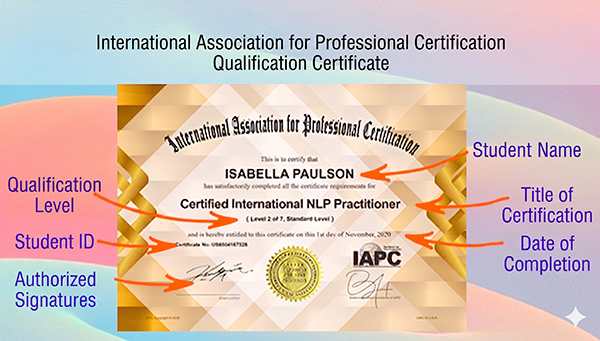
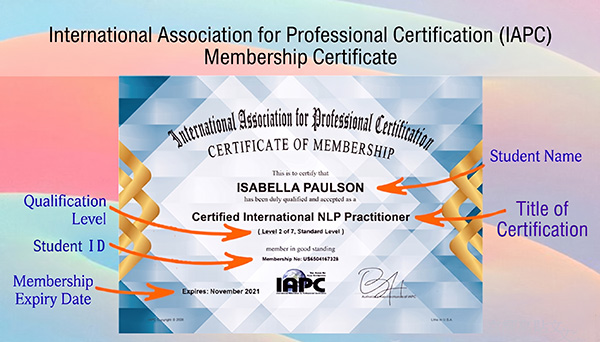
1. IAPC Name and Logo
The IAPC name and logo on a certificate indicate that the certificate has been issued according to IAPC’s relevant certification system, authorization procedures, or review standards. The IAPC name, Logo, certificate design, seal, and layout are important brand assets. Without authorization, they may not be copied, modified, imitated, or used for other certificates, courses, or commercial purposes.
2. Certificate Title
The certificate title indicates the type of document, such as a professional qualification certificate, membership certificate, trainer certificate, course founder certificate, course certification certificate, or other authorization certificate. Different certificate types represent different natures and should not be confused or used interchangeably.
3. Certificate Holder’s Name
The certificate holder’s name identifies the person recognized by the certificate. Applicants should confirm that their Chinese name, English name, and spelling are correct at the time of application. If a spelling error is found after issuance, the certificate holder should contact IAPC Asia as soon as possible and follow the relevant procedures for correction or reissuance.
4. Certification Program Title
The certification program title is one of the most important professional identifiers on the certificate. It indicates the professional qualification field obtained by the certificate holder, such as aromatherapy, hypnosis, NLP, singing bowls, sound healing, mandala art, education and training, career planning, beauty and body care, care services, consulting services, or other professional programs.
The certification program title should be presented according to the Chinese or English title approved by IAPC. It must not be arbitrarily added to, reduced, rewritten, exaggerated, or translated into a title inconsistent with the original certificate. If the certificate title is used in résumés, websites, or promotional materials, it is recommended to present the original certificate wording in full.
5. Qualification Level
IAPC adopts the Seven-Level Qualification System. Certificates may indicate different qualification levels from Level 1 to Level 7 in order to present the certificate holder’s learning stage, professional ability, practical experience, teaching ability, consulting ability, or field contribution level.
The seven qualification levels are: Level 1 Basic Level, Level 2 Standard Level, Level 3 Advanced Level, Level 4 Senior Level, Level 5 Consultant Level, Level 6 Master Level, and Level 7 Lifetime Achievement Level.
6. Issuance Date
The issuance date indicates the official date on which the certificate was issued. The certificate date may serve as a record of learning completion, qualification approval, course completion, or review completion. When using the certificate externally, the certificate holder should refer to the date stated on the certificate.
7. Certificate Number
The certificate number is important information for certificate identification and verification. Certificate holders, students, partner institutions, or third parties who need to confirm certificate information may use the certificate number and related information to verify through the IAPC Asia official certificate verification system or official contact channels.
8. Signature and Seal
Certificates may include authorized signatories, representative signatures, seals, or other certification marks. Such signatures and seals are part of the certificate’s official nature and may not be copied, removed, altered, or used for other documents without authorization.
4. Common Types of Certificates
1. Individual Professional Qualification Certificate
An Individual Professional Qualification Certificate is used to certify that the certificate holder has obtained the corresponding IAPC professional qualification in a specific professional field. This type of certificate may be issued based on the applicant’s course training, equivalent qualifications, practical experience, or review results, and may indicate different levels according to the Seven-Level Qualification System.
2. Membership Certificate
A Membership Certificate presents the membership service relationship between the certificate holder and IAPC. Membership is usually related to certificate verification, data maintenance, membership continuation, subsequent applications, trainer services, or other administrative support. A Membership Certificate and a Professional Qualification Certificate are different in nature and should be understood separately.
3. Trainer Certificate
A Trainer Certificate presents the holder’s teaching, training, or instructional qualification in a specific course or professional program. A Trainer Certificate does not necessarily mean that the holder may apply for IAPC certificates for all courses. The actual scope of authorization should be based on the certificate title, authorization documents, and the content approved by IAPC Asia.
4. Course Founder Certificate
A Course Founder Certificate is generally used to recognize the applicant as the founder of a specific Professional Features Program. It indicates that the applicant has made important contributions to the establishment of the course title, course structure, teaching system, or original methodology. This type of certificate is usually related to a Professional Features Program, PFP, application.
5. Professional Features Program Certification Certificate
A Professional Features Program Certification Certificate indicates that a course has passed IAPC review and has become an IAPC-certified and authorized Professional Features Program. The authorized scope of the course, student certificate application eligibility, certificate titles, and levels that may be applied for should be handled according to the content approved by the association.
6. IAPC Certificates Applied for by Students After Course Completion
After students complete the training content, hours, learning tasks, or assessment standards required by an IAPC authorized trainer or certified course, the authorized trainer or partner institution may assist them in applying for IAPC international certificates in accordance with relevant regulations. Student certificates should be applied for according to the actual completed course content and approved level, and the level must not be arbitrarily raised or the certificate title changed.
5. Differences Among Certificates, Membership, and Authorization
Many users easily confuse “certificates,” “membership,” and “authorization.” Although the three are related, they are different in nature:
| Item | Main Meaning | Explanation |
| Certificate | Certification of professional qualification or learning outcomes | Used to certify that the certificate holder has obtained certification for a specific professional program and qualification level. |
| Membership | Membership service relationship with IAPC | Usually related to data maintenance, membership continuation, subsequent applications, certificate verification, or administrative services. |
| Authorization | Approved authority for courses, trainers, or institutions | Authorized trainers or partner institutions may conduct courses and assist students in applying for IAPC certificates within the approved scope. |
Obtaining an individual certificate does not automatically grant trainer authorization. Obtaining a trainer certificate does not mean that one may apply for IAPC certificates for all courses. Obtaining course authorization should also be handled according to the approved course title, content, level, and application process.
6. Certificate Verification Method
To protect the rights and interests of certificate holders, students, partner institutions, and the public, IAPC Asia provides certificate verification services. If you need to confirm the authenticity of an IAPC certificate, you may use the certificate verification function on the association’s official website or inquire with IAPC Asia through official contact channels.
When making an inquiry, it is recommended to prepare the following information:
1. Certificate holder’s name.
2. Certificate number.
3. Certification program title.
4. Certificate issuance date.
5. Certificate image or scanned copy.
6. Other information that may assist in identifying the certificate.
If the verification result does not match the certificate content or no record is found, please contact IAPC Asia for confirmation. Possible reasons may include incorrect data entry, differences in name spelling, old records not yet imported, certificate number errors, unofficially issued certificates, or other circumstances requiring further verification.
7. How to Identify Certificate Authenticity
When identifying the authenticity of an IAPC certificate, it is recommended to confirm the following:
1. Whether the certificate states the IAPC name or official logo.
2. Whether the certificate clearly states the certificate holder’s name.
3. Whether the certificate has a clear certification program title.
4. Whether the certificate indicates a qualification level.
5. Whether the certificate has an issuance date.
6. Whether the certificate has a certificate number.
7. Whether the certificate wording is consistent with commonly used IAPC formats.
8. Whether the certificate style shows obvious signs of alteration, collage, or modification.
9. Whether the certificate information can be verified through IAPC Asia official channels.
10. Whether the certificate was obtained through an authorized trainer, partner institution, or official application process.
If any suspected forged, altered, impersonated, misappropriated, or privately printed IAPC certificate is discovered, please immediately provide relevant information to IAPC Asia for verification. The association will request correction, stop usage, issue public clarification, or take necessary rights-protection measures depending on the circumstances.
8. Suggested Certificate Usage
Certificate holders may use IAPC certificates within a reasonable scope to present their personal professional qualifications, such as:
1. Personal résumés.
2. Professional profiles.
3. Business cards or personal websites.
4. Course instructor introductions.
5. Professional information on social media platforms.
6. Cooperation proposals or presentations.
7. Learning outcome displays.
8. Professional service descriptions.
When using the certificate, it should be presented according to the original certificate wording, actual level, and correct title. It is not appropriate to rewrite it into a higher-level, broader, or legally authoritative title. If the certificate is issued for a specific course, specific program, or specific level, external descriptions should avoid over-expansion.
9. Important Notes for Certificate Display
If a certificate holder or trainer wishes to display an IAPC certificate on a website, social media platform, poster, presentation, or course page, the following principles are recommended:
1. Display one’s own certificate and do not misuse another person’s certificate.
2. Do not modify certificate content, name, date, number, program title, or qualification level.
3. If displaying a student’s certificate, obtain the student’s consent in advance.
4. If displaying a sample certificate, clearly mark it as “Sample.”
5. Do not use certificate images to imply authorization or qualifications that have not been obtained.
6. Do not provide certificate designs to third parties for imitation or templating.
7. Do not cause misunderstanding through blurring, cropping, collage, or redesign.
8. Do not use IAPC certificates for unlawful, improper, exaggerated, or misleading promotion.
10. Common Correct Descriptions
To avoid misunderstanding, certificate holders, trainers, or partner institutions may use the following descriptions according to their actual status:
| Situation | Recommended Description |
| Individual certificate holder | The certificate holder has obtained IAPC international professional certification in the program stated on the certificate. |
| Authorized trainer | This course is taught by an IAPC authorized trainer. Students who complete the course requirements may apply for IAPC international certificates in accordance with relevant regulations. |
| Authorized course | This course is an IAPC-certified and authorized Professional Features Program. |
| Equivalent Qualification application | This certificate was approved through the IAPC Equivalent Qualification System based on the applicant’s existing qualifications, learning experience, and related materials. |
| Certificate verification | Certificate information may be verified through the IAPC Asia official certificate verification system or official contact channels. |
11. Improper Descriptions to Avoid
To maintain the credibility of the IAPC certification system, certificate holders, trainers, and partner institutions should avoid the following statements:
1. Claiming that an IAPC certificate is equivalent to a government license.
2. Claiming that an IAPC certificate is an academic diploma or national examination qualification.
3. Claiming that holding an IAPC certificate allows legal practice in any country.
4. Claiming that an IAPC certificate can be obtained without taking courses or undergoing review.
5. Claiming that an IAPC certificate guarantees employment, successful business operation, or income.
6. Claiming that an IAPC certificate can replace medical, psychotherapy, legal, financial, or other statutory professional qualifications.
7. Presenting an individual certificate as trainer authorization.
8. Presenting authorization for a single course as authorization for all courses to apply for IAPC certificates.
9. Using expired, revoked, or unauthorized status for enrollment promotion.
10. Modifying certificate content and using it as promotional material.
12. Certificate Correction, Reissuance, and Remaking
If spelling of the name, certification program, date, number, or other information is found to be incorrect after certificate issuance, the certificate holder should contact IAPC Asia as soon as possible and provide relevant supporting documents. The association will confirm whether correction, reissuance, or remaking is available according to the actual situation.
If remaking is required due to incorrect information provided by the applicant, a later request to change name format, loss of certificate, damage to certificate, resending, or other reasons not attributable to the association, corresponding production fees, administrative fees, mailing fees, or other related costs may apply. Actual fees and handling methods shall be subject to the latest regulations of IAPC Asia.
13. Digital Certificates and Printed Certificates
IAPC certificates may be provided in digital form, printed form, or both, depending on the application program, service plan, issuance method, or actual operational needs. Digital certificates are convenient for storage, transmission, and online use, while printed certificates are suitable for physical display, ceremony presentation, course completion events, or formal collection.
Whether digital or printed, certificates should be used according to the officially issued content and must not be modified, reproduced, reprinted, sold, or provided to third parties for imitation. If certificate authenticity needs to be confirmed, IAPC Asia official verification or formal response should be used as the basis.
14. International Mailing and Certificate Preservation
If applicants choose printed certificates, IAPC Asia may assist with certificate mailing according to actual service arrangements. Domestic and international mailing time, fees, logistics methods, tracking information, and delivery status will depend on the destination region, logistics provider, and actual operational conditions.
After receiving printed certificates, certificate holders should preserve them properly and avoid folding, moisture, stains, loss, or providing them to others for use. If the certificate is used for public display, it is recommended to frame or protect it appropriately and avoid allowing certificate numbers or other information to be misused.
15. Certificates and Professional Responsibility
Obtaining an IAPC certificate means that the certificate holder has received a corresponding certification record in a specific professional program. It also reminds the certificate holder to use their professional ability with greater responsibility. A certificate is not the end of professional learning, but the beginning of continuous improvement, ethical compliance, honest service, and maintenance of professional image.
Certificate holders should provide professional services according to their own abilities, training background, and service scope. They must not make false claims beyond their qualification scope, mislead students or clients, or use IAPC certificates as tools for improper enrollment, fear-based marketing, exaggerated therapeutic claims, or unlawful services.
16. Important Statement
IAPC certificates are professional competency certification documents issued by a professional certification organization according to its own system. They are not government licenses, academic diplomas, statutory occupational qualifications, or practice permits issued by competent authorities. If certain occupations or services legally require specific statutory qualifications in the certificate holder’s location, the certificate holder should obtain the corresponding qualifications according to local laws.
IAPC Asia does not encourage any exaggerated, misleading, false, or unlawful use of certificates. All certificate holders, trainers, partner institutions, and third-party users should correctly use IAPC certificates and related titles according to the association’s relevant guidelines, professional ethics, brand usage guidelines, and local legal requirements.
If any certificate is found to be forged, misused, stolen, altered, privately printed, or improperly used, IAPC Asia reserves the right to verify, request correction, terminate authorization, revoke qualifications, issue public clarification, and protect its rights and interests in accordance with the law.
17. Contact and Inquiry
If you have any questions regarding IAPC certificate styles, certificate fields, certificate authenticity, certificate verification, reissuance or correction, certificate usage methods, or related guidelines, you are welcome to contact the association through the contact methods listed on the IAPC Asia official website.
When making an inquiry, it is recommended to provide the certificate holder’s name, certificate number, certificate image, issuance date, certification program title, and related explanations so that the association can assist with verification and response.
18. Conclusion
A certificate is the presentation of professional achievement; verification is the protection of institutional trust; and proper use is the attitude of certificate holders taking responsibility for their own professionalism and the public.
IAPC Asia hopes that clear certificate styles and certificate explanations will help all certificate holders, trainers, students, and partner institutions correctly understand the meaning of IAPC certificates and jointly maintain the credibility and long-term value of the international professional certification system.
Let certificates become records of professionalism, and also symbols of integrity, responsibility, and continuous growth.